
Metal Polishing
The term ‘polish’ has different meanings depending on who you are talking to. The Metal Finishes Guide defines metal polishing as a process that enhances the surface of a part using metal removal. Nearly all industries use polishing because it enhances the surface of a part, making it ready for use or to receive one of our high-performance finishes.
Surface Polishing Methods
- Use of an abrasive belt (sandpaper)
- Use of an abrasive wheel (a wheel manufactured with an abrasive in it)
- In a mass finishing process with abrasive media
All of the processes mentioned above RPA uses to help reach the final finish of a customer's product.
Some surface removal is required, whether it is metal finishing, plastics finishing, or composite finishing. RPA has developed over many years of experience a combination of processes such as vibratory polishing, polishing on a belt or wheel, mass finishing or tumbling, and even bead blasting to achieve the desired finish of the customer.
Metal Buffing
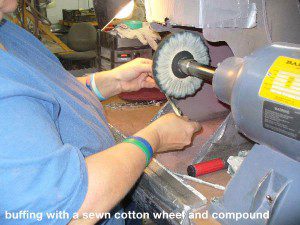
Buffing, unlike polishing, is the process that will give the part its final finish; this can be accomplished in many different ways. Depending on the desired finish of the customer, you can go from bright to dull, or mirrored to a satin or brushed look. The industries that typically utilize this finish include the medical industry, such as hospitals, or any industry where the finished part must look very clean, such as automotive.
Methods for Buffed Finish
- Cotton wheel with a specific compound
- Mass finishing with various media
- Bead blasting
When a customer talks about a buffed finish, it will usually mean a bright, maybe a mirror finish with no scratches or noticeable marks.
Polishing and Buffing Materials We Service
Request a Metal Polishing or Buffing Quote from RP Abrasives
For a free, no-obligation initial polishing/buffing consultation or help to answer any technical or product-related questions, fill out the form below, call us at (603) 335-2132 or contact us online! We’re based in New Hampshire, but we provide services throughout Massachusetts (MA), Maine (ME), Vermont (VT), Connecticut (CT), Rhode Island (RI), New York (NY), and internationally.