
Maximum Corrosion Resistance for Stainless Steel
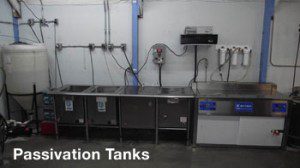 When done right, a chemically-based stainless steel passivation process improves the corrosion resistance of stainless steel. Passivation allows an invisible film to form on the surface once exposed to air or an open-containing environment. This film becomes a sort of shell, protecting from corrosion. For the non-chemists reading this, passivation simply means that with a proper wash, rinse, and soak in a citric acid-based solution—and then a clean rinse and dry after—stainless steel parts will stay corrosion resistant.
Though stainless steel can never be 100% corrosion-proof, our passivation services get as close to it as possible. All our passivation lines use deionized water, so we are not worrying about free iron particles in our passivation lines.
Our wash processes use this same filtered water, assuring that your parts will be ultra-clean. All passivation and cleaning can also be done ultrasonically, allowing the solution to reach even the smallest crevice of the material.
Stainless Steel Passivation Services
- Passivating from small batch sizes to large complex parts
- Passivate using deionized water and citric acid
- Testing of passivated parts with a copper sulfate test
- Cleaning of parts before passivation
RPA passivates according to ASTM A-967-05.7(7.1.1 thru 7.1.1.5), and rinse 7.2 testing is performed according to spec A-967-05.15 practice B. All parts are cleaned or descaled to ASTM spec A-380-06. 5.3, 6.2.1, 6.2.2, 6.2.5, 6.2.8, 6.2.11
Request a Stainless Steel Passivation Quote
For a no-obligation stainless steel passivation consultation, call us at (603) 335-2132 or contact us for a free quote! We’re based in New Hampshire, but we offer services to customers throughout Massachusetts, Maine, Vermont, Connecticut, Rhode Island, New York, and nationally.